
A leading expert in financial technology, inventor, and researcher, Michael Dubno created the SecDB system that became the foundation for modern financial risk analysis at Goldman Sachs. He later developed similar solutions for Bank of America. Let’s take a closer look at the life of this renowned developer who began his career in the Bronx on bronx-future.com.
The Beginning
Michael Dubno was born in Brooklyn to a family already inclined toward media and technology. His older brother, Daniel Dubno, would later become a well-known television producer. The family eventually moved to the Bronx, where Michael’s technical journey began at the Bronx High School of Science. In the 1970s, computers were a rarity not just at home but even in schools. Despite the lack of formal programming classes, Michael taught himself to code on the IBM 1620 and HP 2000E computers the school owned.
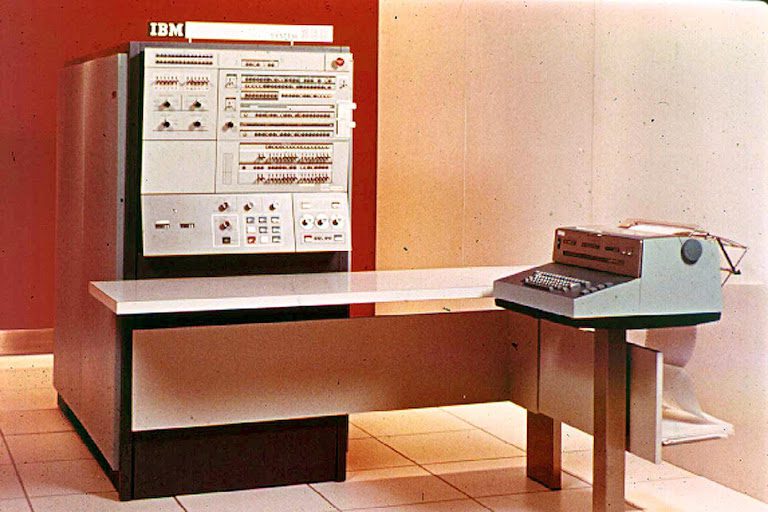
He even discovered and mastered an IBM System/360 computer at Lehman College, a nearby school, before the device was stolen in 1978. At home, he had his own North Star Horizon computer, which further fueled his passion for technology.
In 1981, Dubno enrolled at Rensselaer Polytechnic Institute but, driven by an insatiable desire to create rather than just study, he left after his freshman year. In 1982, he founded his own company, Megasoft, and released the video game Megalegs for Atari computers—one of his first public developments that combined technical knowledge with creativity.
The very next year, Michael embarked on an even more ambitious project: developing his own robot. Starting in 1984, he built a machine in his workshop that not only moved and spoke but also navigated spaces using sonar, had infrared positioning (a precursor to modern GPS), and even a mechanical arm capable of manipulating objects. It was an extraordinarily advanced invention for its time, especially one created by a single person without institutional funding or a lab.
The Programmer
In 1985, Michael Dubno was recruited by Goldman Sachs. He was the first person in the company’s history to be hired into the front office based solely on his programming skills—not for a degree, not for connections, but for his talent with code.
Working in the equities division, Michael began developing internal trading and analytics systems that quickly spread throughout the firm.
“The standard interview question I got at Goldman Sachs and other places was, ‘What’s wrong with a New York City taxi?’ Basically, people who build things see flaws in all the other things around them,” Michael once shared.
In the early 1990s, Dubno moved to the J. Aron currency and commodities division, a Goldman subsidiary. There, in 1992, he created a system that would forever change the approach to financial calculations and risk management: SecDB (Securities DataBase). It was more than just a database. SecDB was an object-oriented system that could store, process, and analyze any number of financial instruments. But it didn’t stop there. Dubno enlisted engineers Kevin Lundin and Glenn Gribble, and together they developed their own programming language, Slang (Securities LANGuage). It resembled Python before Python became mainstream. Slang allowed traders, analysts, and tech staff to create new financial objects, run simulations, generate reports, and automate trading without needing an army of programmers.
SecDB didn’t just work; it became a critical infrastructure for risk management. When financial institutions were reeling during the 2008 crisis, it was SecDB that enabled Goldman Sachs to quickly re-evaluate positions, adjust strategies, and avoid the losses that destroyed other banks.
“One of the first things I did at Goldman Sachs was work in the Goldman equities department. I was working on trading desks that were essentially not computerized, and I started making it so we could trade hundreds of stocks in minutes and things like that. And we were making hundreds of thousands of dollars, millions of dollars in a short period of time,” Dubno recalls.
Former Goldman Sachs president Gary Cohn called SecDB the company’s “key competitive advantage.” In the media, it was repeatedly described as “Goldman Sachs’s most valuable software,” the firm’s “secret ingredient,” an “unmatched trading weapon,” and “something competitors can’t replicate.” All of this was thanks to the engineering vision of one person who knew how to combine an inventor’s creativity with the rigorous logic of a programmer-financier.
The Executive
Michael Dubno rose rapidly through the corporate ranks. At Goldman Sachs, he became a managing director in 1999, a partner in 2001, and then Chief Technology Officer a year later. It was under his leadership that the investment giant transformed into an efficient technological trading platform.
After the financial crisis, Michael Dubno was invited to Merrill Lynch to bring order to its fragmented technical infrastructure. As Chief Technology Officer for Global Markets, Dubno led the company’s digital transformation: he streamlined systems, centralized risk control, and ensured technological stability. He completed the large-scale modernization in five years before leaving the company in its revamped state.
However, Dubno’s activities extend far beyond the corporate world. He is a co-founder of NYC FIRST, an initiative that opens the door to STEM education for New York City youth, especially those from communities with limited access to technology. Under his guidance, modern STEM centers were established, combining learning with hands-on practice in robotics, engineering, and coding.
Michael Dubno’s managerial expertise was also sought after in the startup world. He has served on the boards of directors for Cerebellum Capital, Datapipe, and Tormach. His engineering talent was even trusted with a presidential campaign—in 2008, he became the Chief Technology Officer for Barack Obama’s election headquarters.
Together with his brother Daniel, he also founded Gadgetoff, an unusual festival that became a platform for innovation leaders from around the world to meet. Scientists and entrepreneurs gathered there not only to showcase new inventions but also to contemplate the future of science and technology.
The Explorer
Michael Dubno is not just a technical innovator but also an explorer who seeks to understand the world in its harshest and most inaccessible forms. His participation in scientific expeditions isn’t about tourism; they are deeply considered scientific missions aimed at collecting unique data and developing new technologies for extreme environments. Notable scientific expeditions involving Michael Dubno include:
- The North Pole (2018).
As part of the world’s youngest scientific expedition, he researched microplastics and collected environmental data for NASA’s IceBridge.
- Masaya Volcano (2019).
He studied an active crater in Nicaragua, using drones for thermal mapping, collecting gas samples, and studying extremophile microorganisms.
- Challenger Deep (2021).
He became the 18th person to reach the deepest point of the ocean. He conducted unique experiments, created a geocache, collected samples for microplastic analysis, and performed metal hydroforming at a depth of over 35,700 feet.

In 2020, Michael Dubno co-authored a publication for the British Horological Institute where, with his team, he uncovered evidence of a lunar calendar on the ancient Antikythera Mechanism, one of the oldest analog computing devices in history.
In 2005, he received the honorary title of Mentor Extraordinaire from the American Society of Mechanical Engineers (ASME) for his contributions to engineering education and mentorship.
The Inventor
Michael Dubno is also a prolific inventor. His most significant patents and inventions include:
- Secure communication systems.
Collaborating with Daniel Hillis and others, Dubno developed a series of solutions for secure data transmission. The patented systems use “visas” that regulate data processing according to predefined security policies. The technology provides flexible access control, agent authentication, and adaptive packet routing through an internal secure network.
- Interactive menu with video games.
Patent US4722053 was the first system for restaurants that combined video games and the food ordering process. The invention anticipated the modern touch-screen kiosks now used in McDonald’s, airports, and on airplanes. This patent became a media phenomenon in the 1980s.
- The Sand Table.
An electromechanical coffee table that creates patterns in sand using a magnetic manipulator and internet control.
- Tentalux.
An interactive animated chandelier with six tentacles of directed light, each moving autonomously. It has a camera “eye,” recognizes people, and can be controlled via Alexa, Google Home, or a web interface.
“The tentacle lamp came from a concept—we have a light up above, and every time we have a dinner party, it never lights up what we need it to. So I could have done it with controllable lights, but it’s not as cool as a tentacle,” Michael remembers.
- Gyre.
An animated mobile with three pairs of movable “umbrellas” that display real and forecasted precipitation.
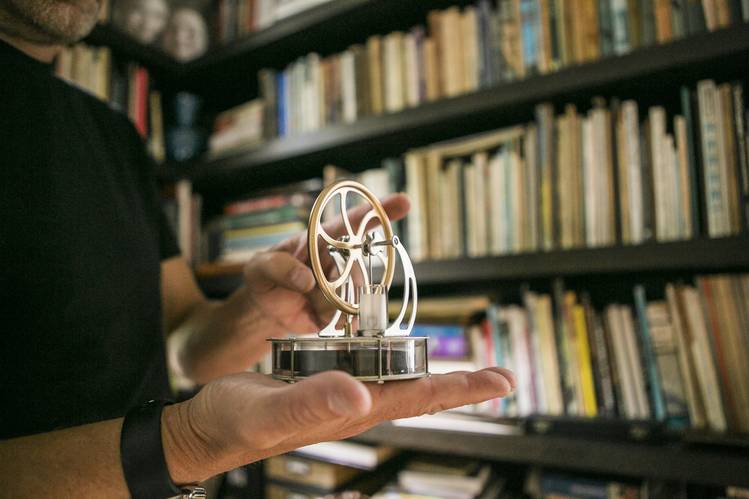
Michael Dubno is a rare example of an inventor at the intersection of engineering, art, and security. He built a career by combining deep engineering expertise with organizational foresight.

