
The internet has long become a utility, but even in a city as developed as New York, there are still many problems in this area. Before Mayor Eric Adams took office in 2020, his predecessor’s administration, led by Bill de Blasio, developed the Internet Master Plan—a large-scale strategy that aimed not just to temporarily provide people with internet access but to completely rebuild the city’s digital infrastructure. What came of this plan and how the new administration continued the initiative is what you’ll find out on bronx-future.com.
The Internet: A Luxury for the Bronx
For many residents of the Bronx, one of New York’s most socially vulnerable boroughs, access to digital technology remains a serious problem. Over 131,000 households in the Bronx do not have broadband internet. And even those who do have access are often forced to rely on a smartphone alone—more than 113,000 households depend exclusively on mobile internet to do homework, search for jobs, or interact with government services.
The cost of internet for many Bronx families isn’t just a line item in the budget; it’s a real burden. For families earning less than $35,000 a year (and there are many of them), network access remains an unaffordable luxury.
Schools and colleges try to help by lending laptops to students and providing training, but the situation gets complicated during breaks. As Lawrence Fontan of Lehman College explains:
“As soon as students leave campus, there’s a sharp reduction in access to internet and resources. At home, they’re often stuck with slow Wi-Fi and several people on one data plan.”
A smartphone is no substitute when you need to fill out a complex government form or attend an online class. Because of this, Bronx residents are often forced to turn to public libraries, which, while they have computers, are critically under-resourced for a borough of millions of residents.
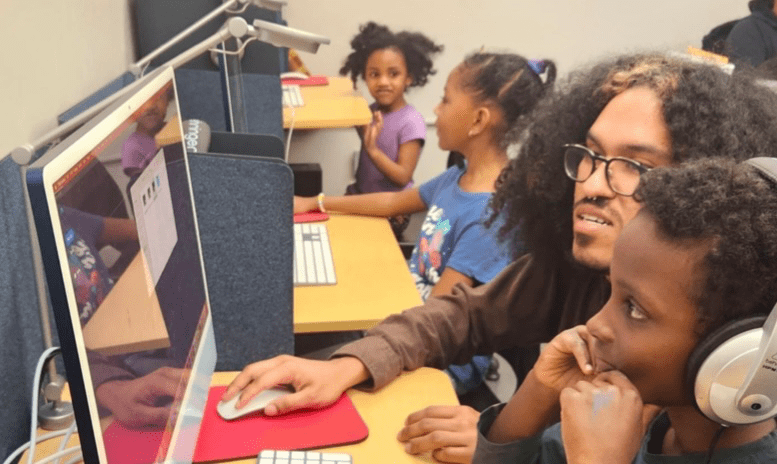
Despite the challenges, non-profit organizations and learning centers in the Bronx are working to provide people with digital skills, help with employment, and give access to technology. But these efforts are not enough to reach everyone who needs help. Strong and thoughtful support from the government is needed.
Bill de Blasio’s Internet Master Plan
The first serious attempt to address the digital divide in New York City, and the Bronx in particular, took place in 2020. During the pandemic, when millions of residents were confined to their apartments, it became clear that surviving, learning, and working without a stable internet connection was nearly impossible. The mayor of New York City, Bill de Blasio, created a Task Force on Racial Inclusion and Equity. Its mission was to listen to residents. And one request rang out the loudest:
“Give us internet access.”
The city then unveiled the Internet Master Plan—the first initiative of its kind in the U.S. The plan promised to do more than just expand Wi-Fi coverage. Its goal was more ambitious: to transform internet access into a basic city right.
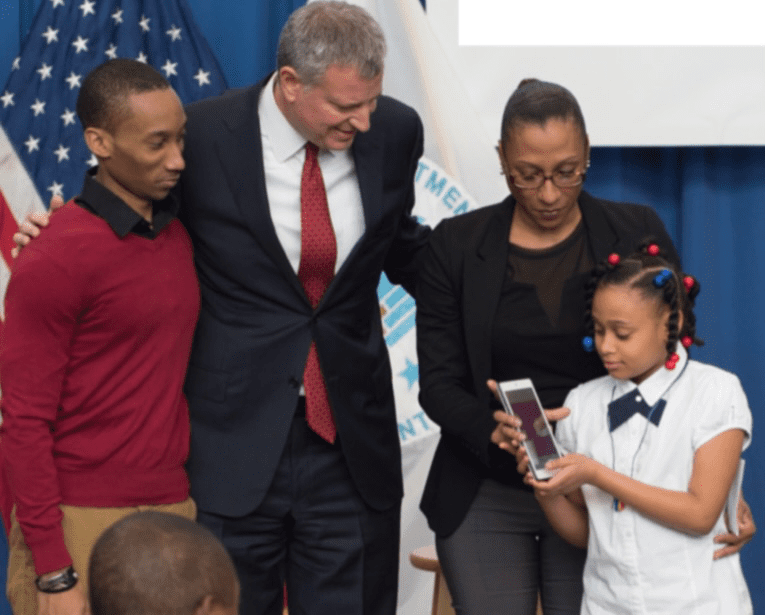
The plan included:
- Deploying an affordable, open-access fiber optic network for 1.6 million residents, primarily in NYCHApublic housing.
- $157 million in investments, the majority of which—$87 million—was reallocated from the city’s police budget to digital infrastructure.
- Partnering with private providers, including small businesses, women- and minority-owned businesses, and non-profit organizations.
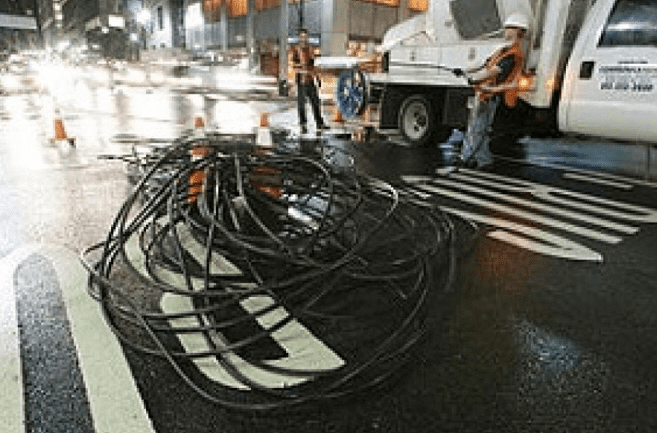
Engineers and urban planners divided the city into several zones based on infrastructure type. In densely built areas like Manhattan and central Brooklyn and Queens, connections were laid underground with fiber optics in tunnels and conduits. In the outer boroughs—in the East Bronx, South Brooklyn, and Staten Island—aerial connections were used via utility poles.
The plan also included placing mobile and stationary wireless equipment on rooftops, streetlights, and even subway stations.
For the first time, the city government developed a public Wi-Fi map that considered the needs not only of tourist areas but also of residential neighborhoods, schools, parks, and libraries.
In addition to internet access, the Master Plan also opened up new economic opportunities. The program planned to train hundreds of young technicians from underserved neighborhoods to install, maintain, and expand the new network. The city created a digital franchise mechanism so that existing providers would have to pay to use city infrastructure instead of getting it for free. The plan projected that 165,000 new jobs would be created and New York City’s gross product would grow by $142 billion.
Pilot projects of the Master Plan were launched in several NYCHA buildings, connecting approximately 30,000 residents to affordable internet through partnerships with selected providers. Organizations involved included NYC Mesh, Silicon Harlem, Sky Packets, Flume, T-Mobile, Starry, and others.
However, in November 2022, the administration of new Mayor Eric Adams unofficially halted the implementation of the Internet Master Plan.
Eric Adams’s Big Apple Connect
The new mayor promised to make New York more tech-savvy, accessible, and equitable. Eric Adams announced Big Apple Connect—a program intended to provide free internet and cable TV to 300,000 residents of NYCHA public housing by the end of 2023.
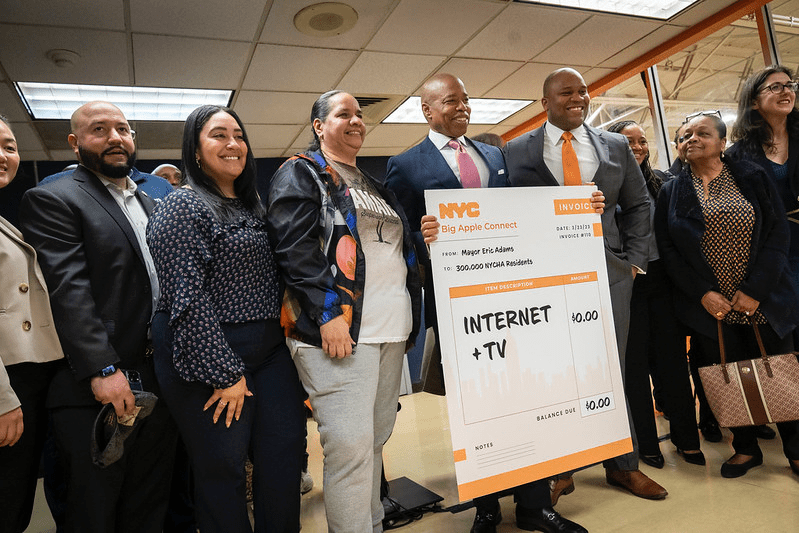
This was, in essence, a large-scale subsidy project: the city purchased internet services from two major market players—Charter Communications and Altice—at wholesale prices (less than $30 a month) and provided them for free to residents of over 200 housing complexes. The program was estimated to cost the city about $30 million a year.
At first glance, this seemed like a reasonable and fair solution. But there were more questions than answers behind it.
Big Apple Connect looked like a quick win. The government was buying services from established giants, not spending time building infrastructure or fostering competition. But critics pointed out several serious problems:
- No new infrastructure was being created. The program relied on the existing networks of large providers.
- Small businesses and minority-owned companies were excluded from the process. They were not even invited to the negotiations.
- The program partially duplicated federal aid — NYCHA residents were already eligible for a $30 monthly internet subsidy through the Affordable Connectivity Program (ACP).
- The administration presented no long-term strategy.
City Council member Jennifer Gutiérrez, who chaired the Committee on Technology, stated directly:
“I am deeply concerned that OTI has failed to provide any detail on long-term plans to get New Yorkers connected beyond Big Apple Connect.”

The mayor’s representatives argued that the Internet Master Plan was too expensive and time-consuming, and residents needed solutions “here and now.”
The administration only pointed to fragmented initiatives like LinkNYC, Connected Communities, digital literacy training, and device distribution. But all of these were a collection of actions, not a cohesive strategy.
Big Apple Connect was a temporary solution that did not replace the systemic approach laid out in the Internet Master Plan.
The NYC Digital Equity Roadmap of 2025
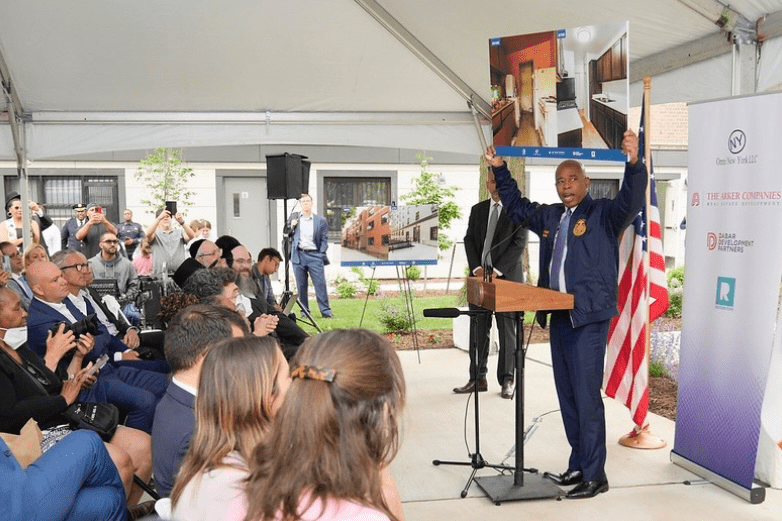
Eric Adams has since acknowledged his mistake in replacing a quality plan with a temporary stop-gap. In 2025, together with the city’s Chief Technology Officer, Matthew Fraser, the mayor announced a massive digital initiative. The plan involves a $2.4 million investment aimed at ensuring the city’s digital equity. The goal is to make technology accessible to everyone, regardless of age, income, or address.
This time, the strategy was prepared with greater care. The published “NYC Digital Equity Roadmap” outlines 11 new projects that combine the efforts of dozens of city agencies and community organizations. They are aimed at ensuring that every resident, from students to seniors, has access to the internet, modern devices, and the skills to use them.
Key steps include:
- Upgrading computer labs in public libraries and senior centers.
- Free Wi-Fi for residents of affordable housing, including households in the Section 8 program.
- Expanding the Big Apple Connect program, which has already provided free internet to over 120,000 NYCHA households.
- Launching a mobile digital van, equipped with computers and printers, that will travel through neighborhoods and stop at the most needed locations.
- Deploying teams of digital navigators who will help New Yorkers use online services, enroll in government programs, avoid online scams, and learn digital literacy.
The initiative pays special attention to seniors and those who do not speak English. They will be provided not only with access to technology but also with support in the form of training, translators, and technical assistance.
Mayor Adams emphasizes:
“Internet, devices, and digital skills are not luxuries. They are necessities for working, learning, getting medical care, and communicating with family. And we are doing everything we can to ensure no one is left behind.”

