

Education, art, architecture, and history—all these elements are intertwined at Bronx Community College. In this article on bronx-future, we’ll tell you about this landmark that has become a national treasure.
Founding the College and its Distinguished Leaders
Surprisingly, Bronx Community College wasn’t originally located in the Bronx itself. In 1957, there was a growing concern about the lack of sufficient educational institutions. At the time, major waves of immigration were taking place, and the young population was increasing. Community organizations and activists advocated for the opening of new schools, colleges, and universities. This led to the founding of Bronx Community College (BCC). However, its first classes were held at Hunter College on 68th Street in Manhattan. It wasn’t until two years later, after the search for a permanent building and confidence in the demand for educational services in this sector, that 125 students began their studies in the former Bronx High School of Science building on Creston Avenue and 184th Street in 1959.
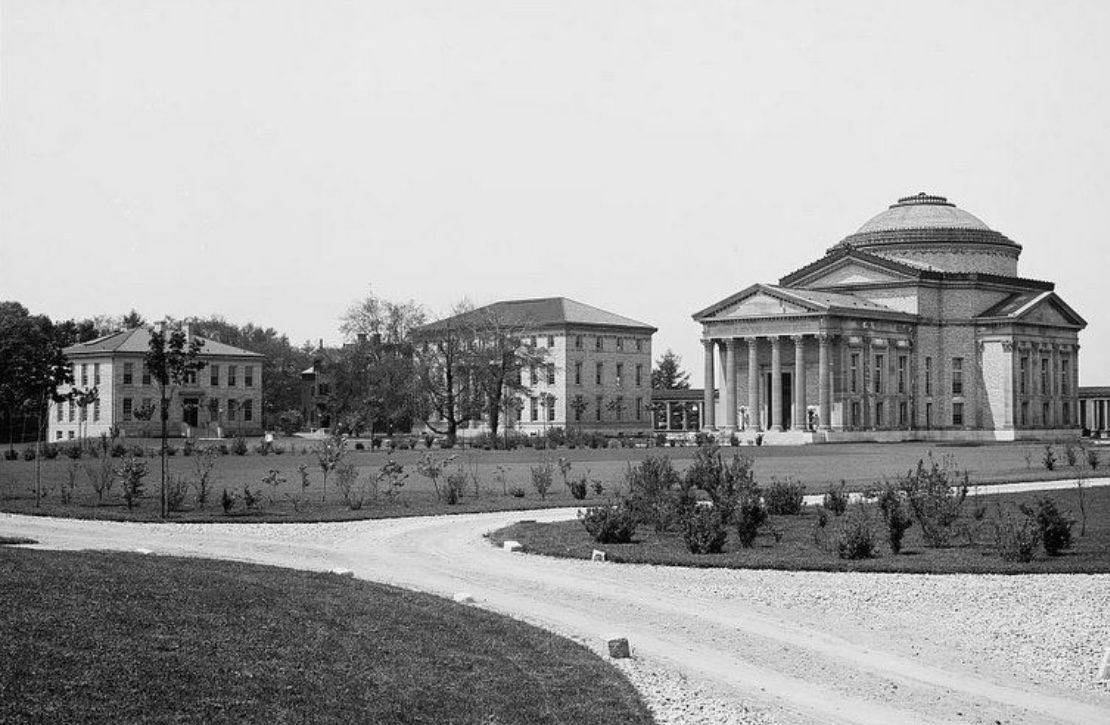
Over the next few years, the college grew rapidly, especially after the introduction of open admissions in 1970. By 1972, it was already serving over 14,000 students and occupying seven neighboring buildings. In 1973, the New York State Dormitory Authority acquired the New York University Heights campus for use by Bronx Community College. Since then, the college has occupied its current 45-acre site overlooking the Harlem River, which includes 34 buildings. BCC has one of the largest campuses in the CUNY system, with an average building age of about 80 years.
The college’s history is marked by many respected and distinguished presidents. Each of them made a specific contribution to the development of this educational institution. But two presidents did the most to make BCC what it is today.
On September 1, 1977, Dr. Roscoe C. Brown Jr. became the third president of the college. During his 17-year tenure, the college strengthened its cooperation with economic and educational institutions of New York, forging partnerships with business and industry to improve graduates’ success. New programs were developed for promising professions in healthcare, technology, and social services.
On August 26, 1996, Dr. Carolyn G. Williams became the fourth president of the institution. During her 15-year term, national and international programs were expanded, including projects in Austria and South Africa, in 2009, construction began on the North Instructional Building and a new library, and a children’s center opened in the spring of 2011.
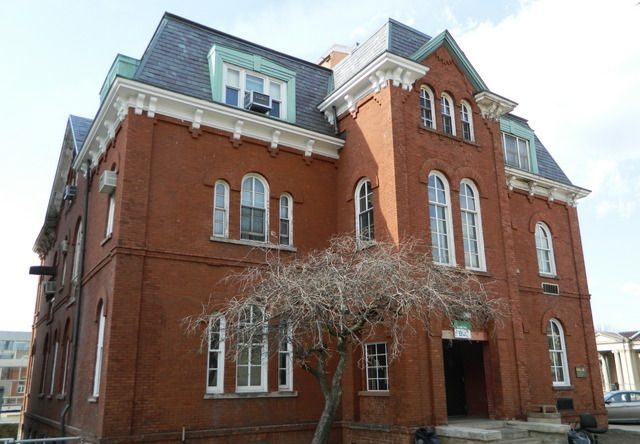
In 2012, BCC became the first community college in the U.S. to be named a national historic landmark by U.S. Secretary of the Interior Ken Salazar, who characterized it as a “nationally significant example of Beaux-Arts architecture.” This initiative was one of the priorities of BCC President Carole Berotte Joseph, who began her duties in 2011. The buildings included in this status were the Gould Memorial Library, the Hall of Fame for Great Americans, Language Hall, Philosophy Hall, and Havemeyer Laboratory.
A Former Mansion and Part of NYU
The Bronx Community College campus was actually once the site of an elite residence known as the Mali mansion, which was built around 1859. It belonged to Henry W. T. Mali, the Belgian consul and an NYU alumnus. This mansion was later converted into the first dormitory on the NYU campus. It had 22 rooms that could house up to 30 students (at the time, only men were allowed).
As for the university itself, it followed the example of other higher education institutions. In the late 1800s and early 1900s, many colleges in New York moved their campuses to the city’s center because they needed more space for their growing number of students. Columbia University moved from 49th Street to Morningside Heights, and the City College of New York moved from 23rd Street to Hamilton Heights. Later, New York University also decided to relocate, moving its undergraduate and engineering schools to the Bronx.
In 1904, architect Stanford White of the firm McKim, Mead & White, known for his works such as the Washington Square Arch and the second Madison Square Garden, was hired to design new buildings for New York University. He created several buildings, including Language Hall, the Cornelius Baker Philosophy Hall, and the Gould Memorial Library. These buildings were funded by wealthy patrons: Mrs. John Steward Kennedy sponsored Philosophy Hall in memory of her father, and Helen Miller Shepherd, the wife of millionaire Jay Gould, funded the Gould Memorial Library.
The Hall of Fame for Great Americans
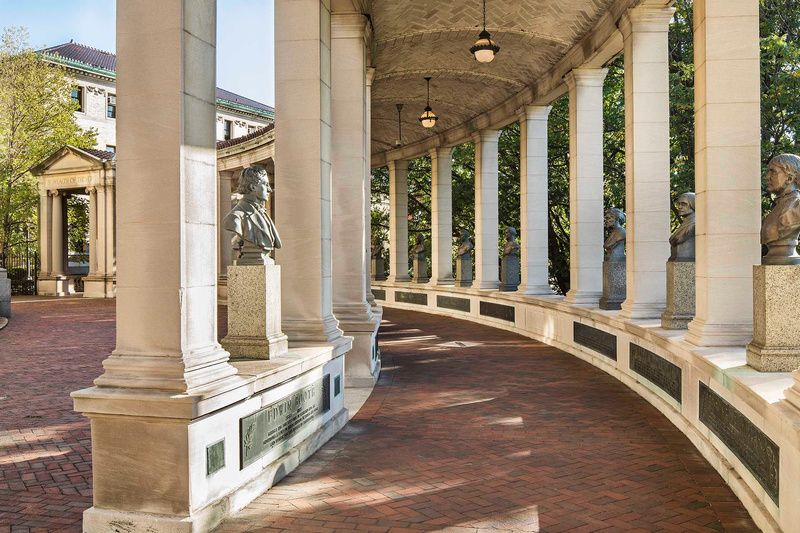
The Hall of Fame for Great Americans at BCC is located at the back of the Gould Memorial Library and offers an incredible view. It was created in honor of the soldiers of the American Revolution who fought to reclaim this territory, which was under the control of the British army. It became the first official place dedicated to people who played an important role in shaping the identity of the United States.
The Hall of Fame was founded in 1900 by Dr. Henry Mitchell MacCracken, a former chancellor of New York University. The chief architect was Stanford White, who designed the neoclassical colonnade.
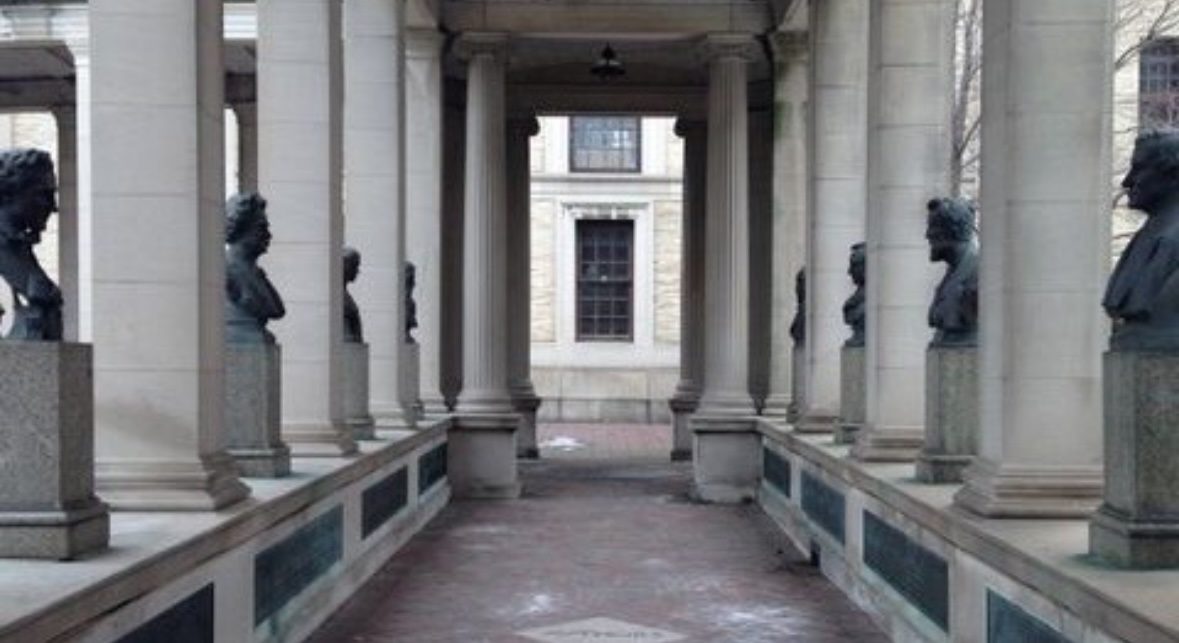
The Hall honors prominent individuals who achieved success in 15 different fields: business, theology, music, medicine, law, invention, and more. Among the celebrities immortalized here are Abraham Lincoln, Susan B. Anthony, Alexander Graham Bell, Alexander Hamilton, John Philip Sousa, and the Wright brothers.
The monument is 630 feet long. Although there are spots for 102 busts, only 98 are currently filled. The last new sculptures were added in 1976. At that time, the collection was supplemented with monuments of Clara Barton, Luther Burbank, and Andrew Carnegie. Below each bust are the name, achievements, and quotes of the prominent individual. The bronze busts were specially made using unique molds for this hall, and there is a strict ban on copying them for 50 years from the date of their installation.
On September 7, 1979, the U.S. Department of the Interior added the Hall of Fame to the National Register of Historic Places.
Gould Memorial Library
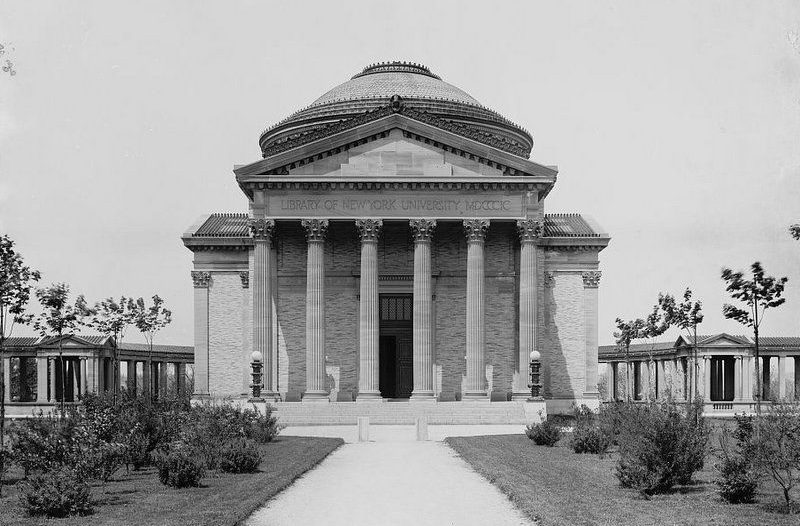
Despite its venerable age and somewhat neglected condition, the main gem of the campus remains the Gould Memorial Library—a true architectural masterpiece created at the turn of the century in 1900.
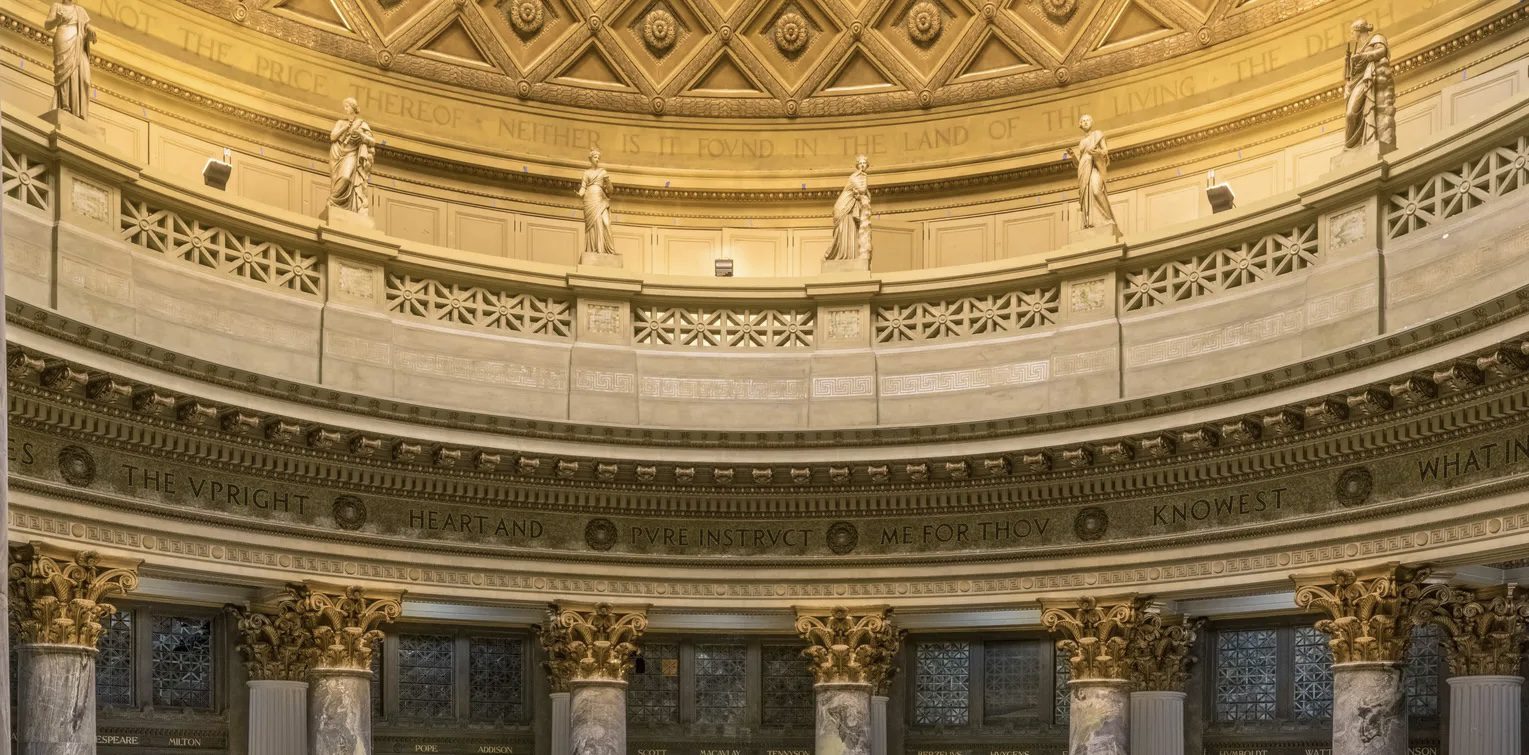
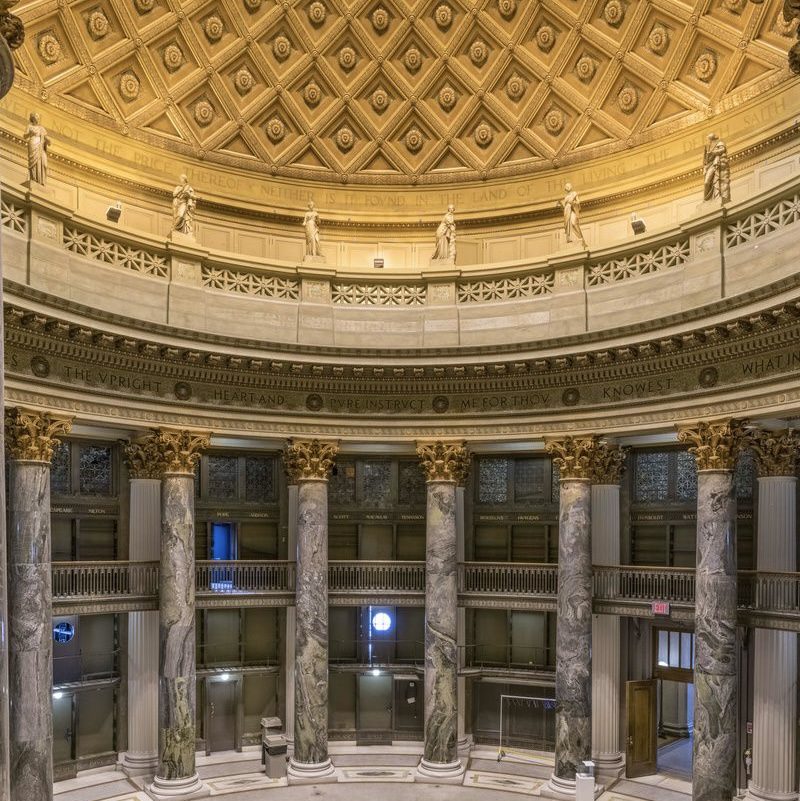
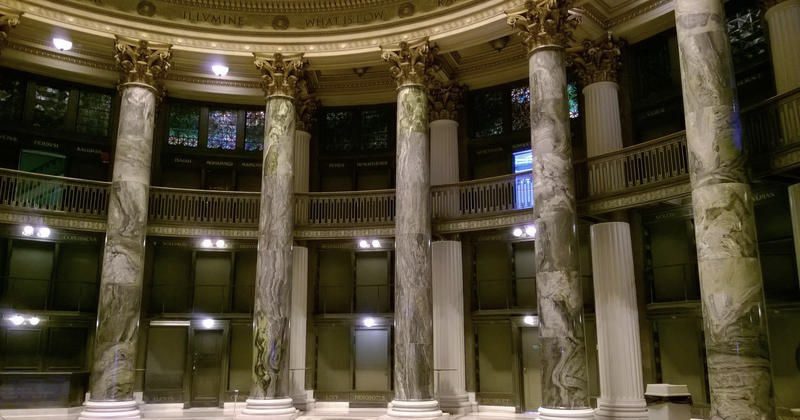
The library consists of a main building and a surrounding arcade terrace. Inside is a large rotunda adorned with 16 Corinthian columns made of rare Connemara Irish green marble. A high dome with an exquisite oculus in the center adds a special charm. Statues of the Greek Muses on the balcony seem to be watching over all who are present. Italian marble mosaic floors and vibrant Tiffany stained-glass windows complete the incredible visual ensemble.
New York University built new libraries for students in the 1950s, but the Gould Memorial Library continued to be used until 1973. At that time, New York was experiencing a financial crisis, which led to the library’s decline due to a lack of funds.
You can read about another architectural monument that is now on the verge of destruction in this article.
Its condition was also affected by an act of vandalism that occurred in 1969. An unknown criminal threw a Molotov cocktail into the library’s premises, which destroyed part of the valuable stained-glass windows and other interior elements.
Today, students use the new library designed by Robert A. M. Stern, but the auditorium beneath the old library’s main reading room is still used for ceremonial events.
Despite years of neglect, the future of the Gould Memorial Library looks promising. The Bronx Community College Foundation plans to transform this library space into a Center for Community Development and Activity, but this will require a lot of restoration work.
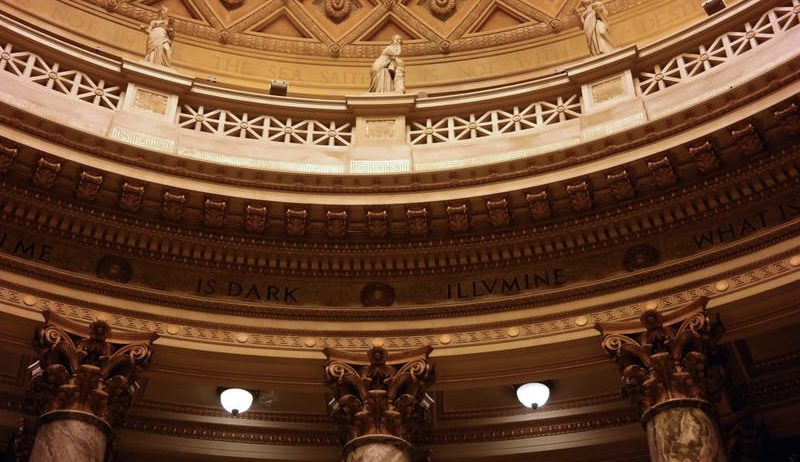
In March 2016, the old BCC library was included in the “Seven to Save” list, which selects the most valuable endangered sites in New York State. Preliminary estimates suggest that more than $50 million is needed for the restoration.
The great-grandson of architect Stanford White, Samuel G. White, currently leads the “Save Gould Memorial Library” initiative, which is dedicated to studying restoration needs and raising funds.
Read the history of another historic building in the Bronx that was also a college at one point here.